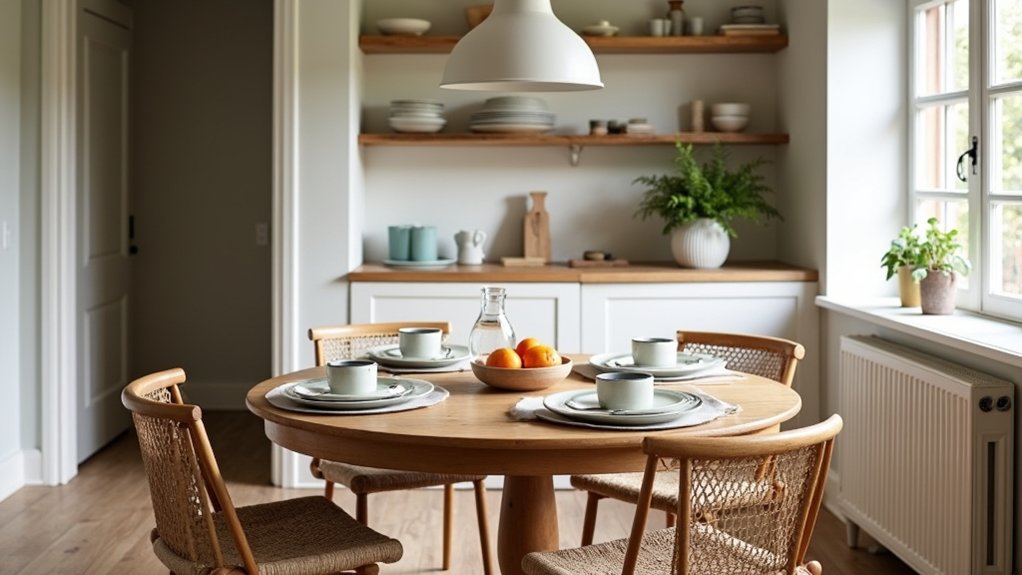

Coincidentally, the dining area is where you end up working, eating, and sorting mail in the same hour. You’ll want a layout that keeps walkways clear, a table that fits your room and routine, and seating that stays comfortable past dessert. Choose wipeable finishes, layer task and ambient lighting, and add a few restrained accents plus hidden storage to control clutter. Next, you’ll set it up so it looks pulled together even on busy nights…
Plan Your Dining Layout: Clearances and Flow
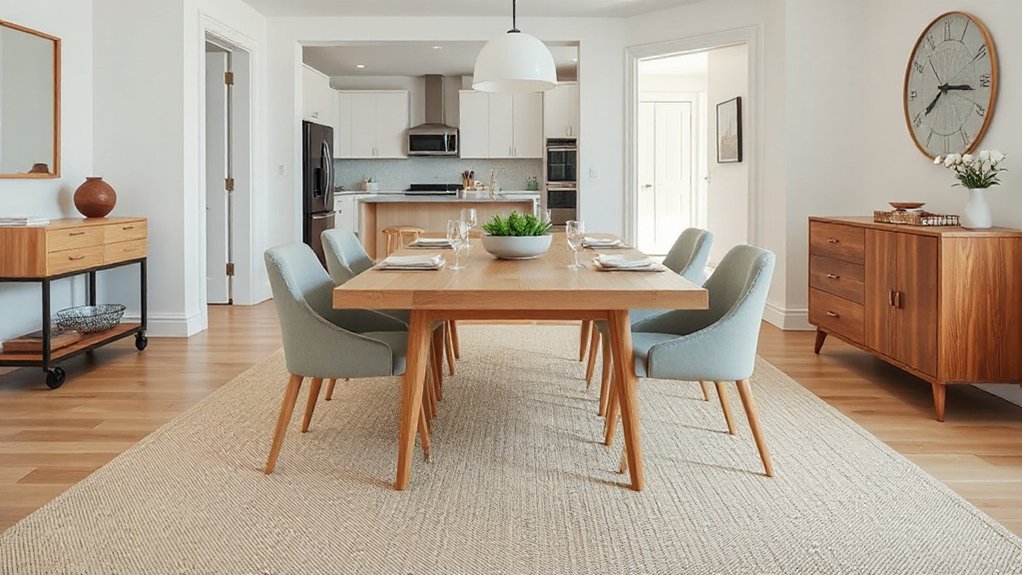
Before you pick a table or hang a pendant, map your dining layout so people can move easily and seats feel effortless to use. Tape the footprint on the floor and mark pull-out zones for chairs so you can check clearances in real time. Keep main walkways wide enough for two people to pass without sidestepping, and protect door swings and cabinet access.
Align the dining zone with natural traffic paths from kitchen to living area, so you don’t create pinch points. Plan a landing spot for serving—console, cart, or counter edge—so dishes don’t bottleneck.
Then layer ambient lighting that spreads evenly without glare, and position wall decor where it won’t get clipped by moving chairs.
Choose a Dining Table: Size, Shape, Seating
Now you’ll pick a dining table that fits your room and the way you actually move through it, so measure for the right length, width, and leg clearance before you shop.
Choose a shape that supports flow—round and oval keep corners out of traffic paths, while rectangular tables maximize seating in longer rooms.
Then match seating capacity to comfort by planning realistic chair spacing, allowing for host chairs, and leaving enough elbow room for lingering meals.
Right Table Dimensions
How do you land on a dining table size that feels generous, not cramped? Start with clearances: keep 36 inches from table edge to walls or major furniture, and aim for 42 inches if it’s a busy pass-through.
Allow 24 inches of width per person and at least 15 inches of shared elbow room between place settings, so everyone can eat comfortably. A 60-inch table typically seats six; 72 inches seats eight, especially with slimmer chairs.
Match scale to your lighting: the table should be about two-thirds the width of your chandelier or pendant cluster.
Choose Table material and Table color that visually “weigh” right—light oak or pale stone reads airier, while dark walnut feels substantial.
Shape And Room Flow
Although size sets the baseline, your table’s shape ultimately controls how smoothly people move through the room and settle in.
In tight or pass-through dining zones, a round or oval table softens corners, reduces snag points, and keeps circulation intuitive.
In long, narrow rooms, a rectangular table reinforces architectural harmony by echoing the room’s lines, but choose a slimmer profile so pathways don’t pinch.
Square tables suit compact, symmetrical nooks, especially when you want balanced sightlines.
For open-plan layouts, match shape to traffic: place a rectangle parallel to the main walkway, or float a round table to keep flow 360 degrees.
Always check spatial proportions against door swings, built-ins, and adjacent island clearances.
Seating Capacity And Comfort
If you plan seating around real life—not just the table’s stated capacity—you’ll end up with a dining setup that feels generous instead of cramped. Count on 24 inches of edge per person and at least 36 inches of clearance behind chairs for pull-out and traffic; in tighter rooms, 30 inches can work with slim silhouettes.
Match shape to use: round tables seat more flexibly, while rectangles handle big dinners. Try bench seating on the wall side to tuck in bodies and reclaim aisle space; add a backrest if you linger over meals.
Prioritize cushion comfort with medium-firm foam, stain-resistant performance fabric, and removable covers. Keep seat height around 18 inches and allow 10–12 inches from seat to tabletop apron so knees don’t collide.
Pick Dining Chairs (or a Bench) for Comfort
When you pick dining chairs (or a bench), prioritize ergonomic support—look for a supportive back angle, a comfortable seat depth, and cushioning that won’t compress fast.
Match seating height to your table so you’ve got about 10–12 inches between the seat and tabletop for easy legroom and a polished look.
If you’re eyeing a bench for a trend-forward vibe, add a backless option only where you can pull it out easily and pair it with supportive chairs on the other sides.
Prioritize Ergonomic Support
Before you fall for a dining chair’s silhouette, check how it supports your body through a full meal (and the inevitable extra hour of conversation). Aim for a backrest that meets your mid-back, with a gentle curve that encourages ergonomic posture instead of slouching.
If you love the airy look of wishbone or spindle styles, test for pressure points along your shoulder blades and lower back.
Choose seats with supportive cushions that don’t bottom out; high-resilience foam wrapped in batting feels tailored and stays comfortable.
On benches, add a contoured pad and a few lumbar pillows so you don’t perch on the edge.
Upholstery matters, too: textured bouclé and performance linen look current, resist stains, and keep you from sliding. Sit, shift, and lean back—comfort should stay consistent.
Choose Seating Height Wisely
Although a chair can look perfect under your table, the wrong seat height makes every meal feel awkward—knees jammed, shoulders lifted, or feet dangling—so dial in the measurements first.
Aim for 10–12 inches between the seat and tabletop, and check that your thighs clear the apron. If you’re mixing chair styles, keep seat heights consistent so guests don’t perch or slump.
For benches, choose a slightly lower seat to slide in easily, then add a slim cushion for seating comfort without crowding the table edge.
Need flexibility? Pick chairs with subtle height adjustment or swappable glides to level on uneven floors.
Finally, sit for five minutes before buying—trend-proof comfort always looks polished, every day.
Choose Easy-Clean Dining Materials (Kids, Pets)
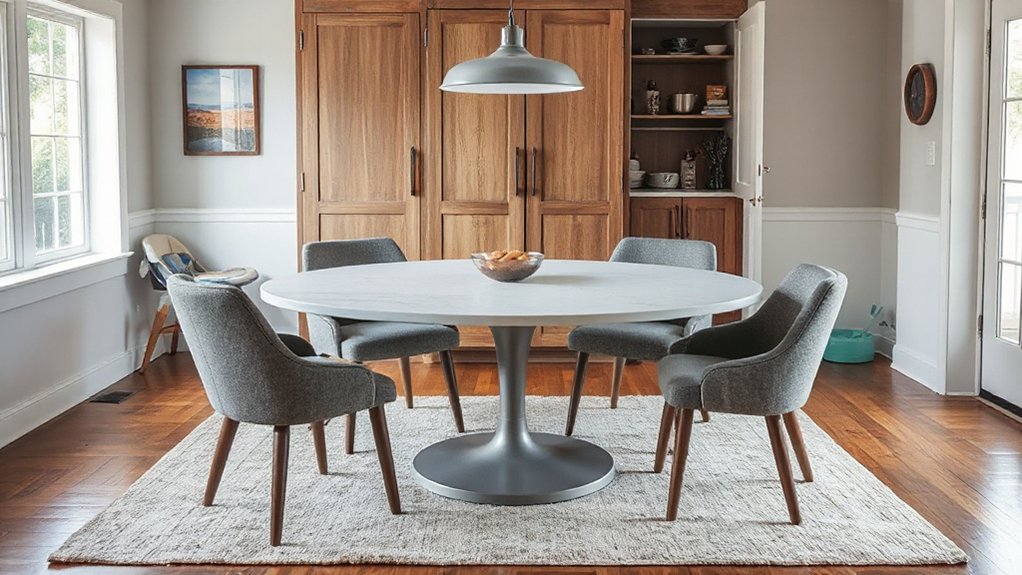
Since spills and scuffs are part of daily life with kids and pets, pick dining materials that wipe down fast and won’t show every mark. Start with durable surfaces: sealed wood, laminate, quartz, or sintered stone resist stains and won’t need babying.
If you love marble, use it on a sideboard, not your main table. Choose matte or textured finishes that hide fingerprints better than high gloss.
For chairs, pick performance fabric, leather, or faux leather so crumbs and fur vacuum up quickly; skip loose weaves that snag.
Add a washable rug (flatweave or indoor-outdoor) to catch messes and protect floors.
Keep Easy maintenance in mind: rounded edges, fewer seams, and removable seat cushions make cleanup faster.
These choices stay sleek, modern, and family-proof.
Get Dining Lighting Right for Work and Meals
When your dining table doubles as a homework station, a WFH desk, and a place to unwind over dinner, you need layered lighting that adapts fast. Start with a dimmable overhead pendant centered on the table; hang it about 30–34 inches above the surface so faces look bright, not shadowed. Choose warm-white LEDs (2700–3000K) for an inviting ambient glow at meals.
Add task illumination for work: a plug-in sconce, slim floor lamp, or directional spotlight aimed at the tabletop. Go higher CRI (90+) so papers and food colors read true, and avoid glare with a matte shade or diffuser. Put everything on separate switches or smart dimmers so you can flip from focus to relaxed in seconds.
Style the Dining Area: Simple Decor + Smart Storage
If your dining table pulls double duty, you can keep the area looking styled—not chaotic—by pairing a tight decor edit with storage that works hard. Start with one anchored centerpiece: a low bowl, a small vase, or a sculptural tray, then stop. Add two functional decor accessories you’ll actually use—candlesticks, coasters, or a linen runner—so the surface clears fast.
Lock in cohesive color schemes: pull two neutrals from your rug or curtains, then add one accent tone (olive, terracotta, or inky blue) through napkins and art.
For storage, slide lidded baskets under a console for papers and chargers, and use a slim bar cart to corral placemats, extra cutlery, and board games. Keep one drawer empty for daily drop-zone clutter.
Conclusion
You’ve planned the flow, so the room feels open—not awkward. You’ve sized the table, so it seats everyone—without crowding. You’ve chosen chairs or a bench for comfort—yet kept silhouettes light. You’ve leaned into easy-clean finishes for real life—while staying trend-forward with warm woods, matte metals, and performance fabrics. You’ve layered lighting for tasks and mood—bright when you need it, soft when you don’t. Finally, you’ve styled with minimal decor and hidden storage—lived-in, not cluttered.