

Painted concrete floors occupy an interesting middle ground — popular enough to be the first option most people consider when faced with a bare concrete surface, yet frequently the subject of disappointment when the paint chips, peels, or blisters within a year of application. The honest assessment of painted concrete floors sits somewhere between the enthusiastic marketing of paint manufacturers and the categorical dismissal of specialist coating contractors, both of whom have obvious commercial reasons for their positions.
The reality is more nuanced. Painted concrete floors work very well in certain settings, with appropriate paint types and proper preparation. They perform poorly when mismatched to their environment, applied without adequate surface prep, or expected to last as long as more permanent finishes. Understanding where the dividing lines sit is the purpose of this guide.
If you’re still deciding on color before committing to the painted approach, our guide to colors for concrete floor paint covers the full palette of options available across different paint types.
What Painted Concrete Floors Actually Are
Concrete floor paint is a surface coating — it sits on top of the concrete rather than chemically penetrating it. This is the fundamental distinction between paint and stain that shapes almost every pro and con on this list. Because paint is a film applied to the surface rather than a reaction within it, the bond between the paint and the concrete is mechanical (grip from surface roughness and pore penetration) rather than chemical. Strong mechanical bonds are possible with proper preparation — but they’re always more vulnerable to undermining forces (moisture, abrasion, impact) than chemical bonds.
The main categories of concrete floor paint available in the UK were covered in the colors guide, but to recap briefly: water-based acrylic floor paints are the easiest to apply and widest in color range; single-pack polyurethane floor paints offer better durability; two-part epoxy systems provide the most hardwearing surface but with a more limited color range and more demanding application process. Each category has a different balance of pros and cons, but the fundamental advantages and disadvantages of painted concrete as an approach apply across all of them.
The Pros of Painted Concrete Floors
Cost — the Most Compelling Advantage
Painting a concrete floor is significantly cheaper than almost any alternative. A can of quality floor paint covers approximately 10–12m² per litre; a 5-litre tin suitable for a typical 40m² garage floor costs £25–£60 depending on type and brand. Materials for a basic concrete floor paint job — primer, topcoat, application tools — typically come to £100–£250 for a standard domestic space. A day’s labour if professionally applied, or a weekend’s DIY effort if self-applied.
Compare this to polished concrete (£25–£70 per m² professionally applied), stained concrete (£15–£65 per m² depending on complexity), tile (£30–£80 per m² installed), or engineered hardwood (£40–£90 per m² installed), and the cost advantage is obvious. For spaces where the floor needs to be functional and presentable without a significant budget, painted concrete is genuinely the most accessible option.
The caveat — which appears in the cons section — is that the lower upfront cost needs to be weighed against the reapplication frequency. A floor that costs £200 to paint and needs repainting every two to three years costs more over a decade than a floor that costs £600 once and lasts fifteen years.
Ease of Application
Applying concrete floor paint is within the capability of most competent DIYers. Clean the floor, etch or grind the surface, apply primer, apply one or two topcoats with a roller. The process is familiar to anyone who has painted a wall, with the additional steps of surface preparation that concrete specifically requires.
Water-based acrylic floor paints are particularly straightforward — they dry in two to four hours between coats, clean up with water, and emit relatively low VOCs during application. Single-pack polyurethane and epoxy-modified products are slightly more demanding but still within DIY reach. True two-part epoxy systems require more care — the pot life (the window between mixing and the point where the material starts to harden in the bucket) is typically 20–40 minutes, which demands working at pace and in manageable sections.
For anyone wanting a weekend transformation of a utility room, basement, or garage, painted concrete floors deliver visible, immediate results with modest skill requirements.
Immediate Visual Improvement
A painted concrete floor transforms a space. Bare concrete in a UK domestic setting — typically a dusty, grey, slightly pitted slab — produces a functional but uninspiring environment. A coat of mid-grey polyurethane, or sage green acrylic, or warm terracotta epoxy-modified paint produces a floor that reads as finished, clean, and considered. The improvement in the overall feel of the space is immediate and significant relative to the investment involved.
This is the quality that makes painted concrete floors particularly popular for garage conversions, basement habitation projects, utility rooms, and workshop spaces — areas where the floor needs to be presentable without being the main design feature.
Dust Suppression
Bare concrete produces dust — fine particles of degraded cement and aggregate that accumulate on surfaces, clog filters, and generally make any space with an unpainted concrete floor harder to keep clean. Painting the floor seals the surface and stops this dusting at source. For a workshop or utility room where dust contamination is a practical problem — it affects tools, finishes, stored items — this benefit alone can justify painting.
Slip Resistance Options
Many concrete floor paints can be specified with anti-slip additives — fine aggregate or rubber crumb mixed into the final coat, or applied wet onto the freshly painted surface and then sealed over. This is particularly relevant for outdoor concrete (paths, patios, entrance steps) and for any wet-area indoor application (utility rooms, pool surrounds, boot rooms). Anti-slip concrete floor paint provides a degree of safety that bare, slightly worn concrete often doesn’t.
Moisture Resistance (in the Right Circumstances)
Some specialised concrete floor paints — particularly epoxy-modified and true two-part epoxy formulations — provide a degree of moisture resistance that helps protect against minor surface dampness. For light domestic use where the floor is slightly damp rather than actively wet, a quality paint system provides a useful additional barrier.
This advantage evaporates, however, where significant moisture movement through the slab is present — which is covered at length in the cons section.
Reversibility
Unlike permanent floor finishes — tiles bonded in adhesive, polished concrete, or poured self-levelling compounds — paint can be stripped and the concrete returned to bare or repainted in a different color. This reversibility is genuinely useful in spaces where the use changes over time. A garage painted grey for vehicle storage, converted to a home studio, can be repainted in a more suitable finish without the disruption of a full floor replacement.
The Cons of Painted Concrete Floors
Durability — the Most Significant Limitation
This is the con that surprises people most consistently, because the marketing of floor paints emphasises durability and the reality often falls short of expectations. Paint doesn’t penetrate into the surface like concrete stains do, so expect to deal with chips and peeling over time. The lifespan of concrete floor paint depends heavily on the paint type, the preparation, the traffic load, and the moisture conditions — but realistic expectations are:
- Acrylic floor paint in a domestic setting: 1–3 years before touch-ups or repainting are needed
- Single-pack polyurethane in moderate-traffic domestic use: 3–5 years
- True two-part epoxy in a well-prepared, dry floor, light traffic: 5–10 years
- True two-part epoxy in vehicle traffic or chemical exposure: 3–5 years
These are not the ten-year lifespans that packaging sometimes implies. High-traffic areas — the path from the door to the car, in front of the workbench, under a chair that scrapes back and forth — show wear visibly before the rest of the floor, producing an uneven, patchy appearance that’s difficult to repair attractively without repainting the whole floor.
The underlying reason is mechanical: paint sits on the concrete surface and takes every impact, scrape, and abrasion that the floor receives. There’s no depth of material to wear through — it’s a thin film. Concrete stain, by contrast, has no surface film to wear through — the color is in the concrete, not on it. This distinction explains why a stained concrete floor holds its appearance significantly longer than a painted one under equivalent traffic conditions.
Moisture — the Primary Technical Risk
Moisture issues are the primary risk with painted concrete floors, and they’re the source of the most common and most frustrating failures. The mechanism is straightforward: concrete is porous, and moisture within or beneath the slab migrates toward the surface through capillary action. Any coating applied to that surface — paint, epoxy, or other — traps the moisture beneath it as the surface dries. The moisture pressure builds until it overcomes the adhesion of the coating and the paint blisters, bubbles, and ultimately peels.
This isn’t a failure of the paint — it’s a failure of the specification. Paint should not be applied to a concrete floor with active moisture movement through the slab. The plastic sheet test (tape a 300mm square of polythene flat to the floor for 48 hours — condensation on the underside confirms moisture movement upward through the slab) is essential before any painting. Basements and ground-floor slabs are the most commonly affected.
Where moisture is present, the options are: address the moisture source and the damp-proof condition of the slab before painting; use a specifically moisture-tolerant primer system (DPM primers designed for damp concrete) with a breathable topcoat; or accept that the floor is not suitable for painting and choose a different approach — a cavity drainage membrane, a floating floor over a DPM, or a breathable surface treatment.
Slipperiness When Wet
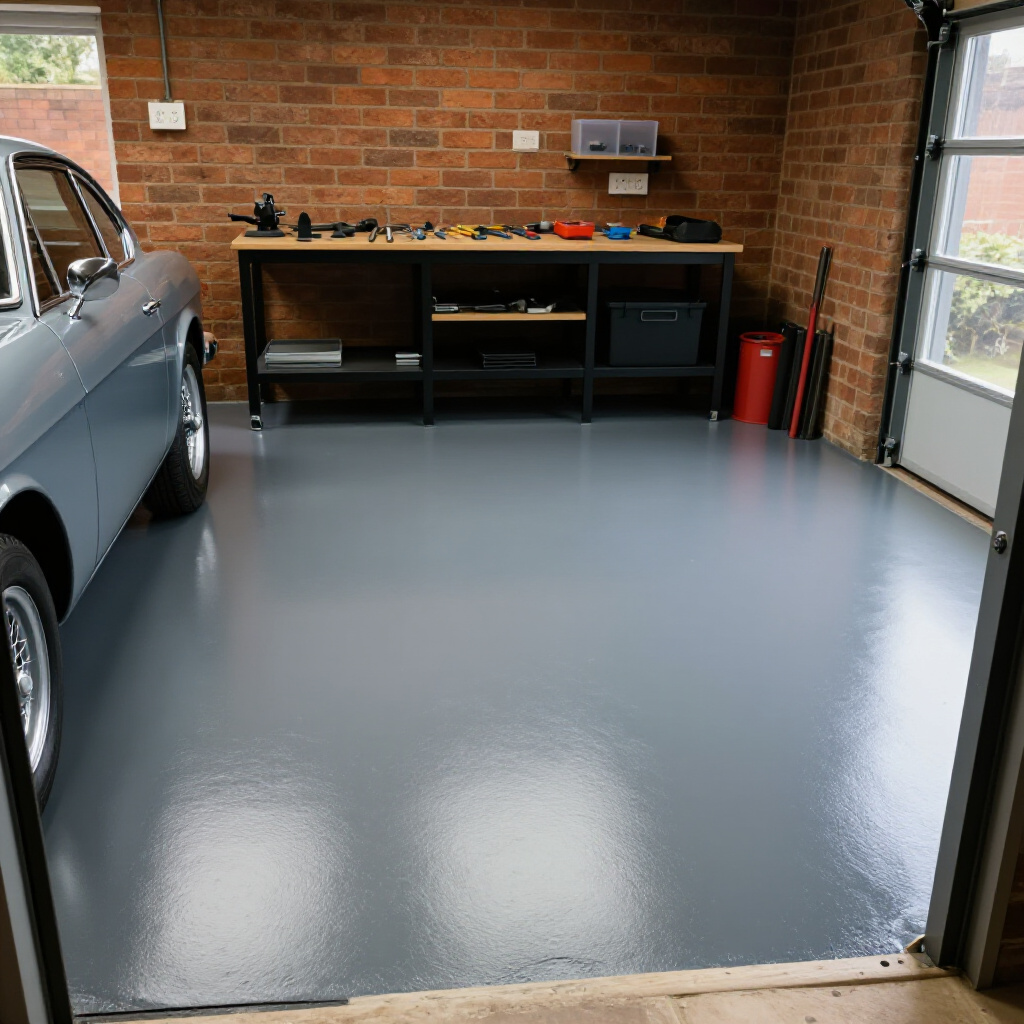
A gloss or satin painted concrete floor becomes slippery when wet — more so than bare concrete, which has some inherent surface texture. In any space where water is likely to be present — a boot room, utility room, patio, or anywhere near external doors — a painted floor without anti-slip additive creates a genuine slip hazard, particularly for older occupants, children, or anyone carrying objects.
Anti-slip additives solve this problem effectively when incorporated correctly, but they’re often treated as an optional upgrade rather than a standard specification for these applications. Any painted concrete floor in a wet area or high-humidity space should include anti-slip provision as a baseline.
Surface Preparation is Non-Negotiable — and Often Underestimated
Paint is only as durable as the surface it’s bonded to. Concrete floor paint applied over an oily, contaminated, or poorly profiled surface will fail within months regardless of paint quality. The surface preparation requirements for a successful painted concrete floor are:
- Complete removal of any existing paint, sealer, or coating
- Thorough degreasing — oil contamination is the most common cause of adhesion failure in garages and workshop floors
- Mechanical profiling — the surface must have open pores and texture for the paint to key into. New concrete with a very smooth finish, or old concrete that has been polished or treated with a surface hardener, requires grinding or acid etching before painting
- Crack and defect repair — painting over unfilled cracks produces paint failure at those points within weeks
- Priming — a floor paint applied without primer over bare concrete has significantly shorter adhesion life than one applied over a properly chosen primer
The preparation typically takes longer than the painting itself, and it’s the step that DIYers are most likely to abbreviate — with predictable results. A floor paint is only as good as the primer beneath it. Many people try to save money by skipping this step, but on a floor, that is a recipe for disaster.
Peeling in High-Traffic Areas
The failure mode most associated with painted concrete floors is localised peeling in the areas of highest stress — the areas that receive the most concentrated abrasion. Entry points, pivot points (where a chair or stool swivels), and the edges of heavy items that move slightly over time are the first places that painted concrete floors show damage.
Once a painted floor begins to peel, the damage accelerates — moisture gets under the lifted edges, the adhesion fails progressively, and what started as a small chip becomes a spreading area of detachment. Touching up localised paint failures is possible but rarely invisible — the repaired area reads differently from the surrounding aged paint.
This failure mode is more pronounced on floors where the paint system includes multiple layers applied at different times (some original, some touch-up) in slightly different shades or finishes, producing a visual patchwork.
Limited Aesthetic Range Compared to Stained Concrete
Paint covers concrete uniformly and opaquely. The natural character of the concrete — the aggregate, the subtle tonal variation, any existing patina — is hidden entirely. For a utilitarian floor where appearance is secondary to function, this is neutral. For a decorative floor where the goal is an attractive living space, it limits what’s achievable. Concrete stain, which reacts with or penetrates the concrete rather than covering it, produces the mottled, characterful, organic appearance that has made decorative concrete popular; paint produces a uniform color field that doesn’t read as natural stone or aged material in the same way.
For anyone who values the genuine aesthetic quality of exposed concrete — the variation, the depth, the sense that the surface has been revealed rather than painted — stained and sealed concrete will always be more satisfying than painted concrete. If uniform color is the goal, paint is appropriate. If character is the goal, paint is not the best vehicle for it.
Not Appropriate for All Concrete Conditions
Concrete that is actively crumbling, significantly cracked, or structurally deteriorating is not suitable for painting — the paint follows the concrete’s movement and fails along with it. Painting over damaged concrete is at best a temporary cosmetic fix that obscures problems rather than addressing them.
Similarly, concrete with significant efflorescence — the white mineral deposits that indicate active moisture movement through the slab — should not be painted until the moisture source has been addressed. Painting over efflorescence traps the salts beneath the paint, which continue to crystallise under the surface and push the paint off from beneath.
How Painted Concrete Compares to the Alternatives
| Comparing | Painted Concrete | Stained Concrete | Epoxy Coating | Tiled Floor |
|---|---|---|---|---|
| Cost | Low | Medium | Medium-High | Medium-High |
| DIY-friendly | Yes | Moderate | Moderate-No | Moderate |
| Durability | 1–5 years | 10–20 years | 5–10 years | 20+ years |
| Moisture tolerance | Low | Low-Medium | Medium | High (with grout) |
| Repairability | Easy but visible | Specialist | Moderate | Moderate |
| Aesthetic range | Wide colors | Organic/natural | Limited | Very wide |
| Reversible | Yes | No | No | No |
Where Painted Concrete Floors Work Well — and Where They Don’t
Good applications:
- Garages and workshops where repainting every few years is acceptable and the budget doesn’t support a full epoxy system
- Utility rooms, boot rooms, and basement spaces with confirmed-dry slabs and light traffic
- Patios and outdoor concrete where a seasonal refresh is part of the maintenance routine anyway
- Rental properties where low upfront cost and ease of future refresh are priorities
- Temporary or transitional spaces where the floor may be changed as part of a future renovation
Poor applications:
- Any slab with confirmed moisture movement through it — painting will fail
- Garages with regular vehicle parking — tyre pickup, hot tyre contact, and oil exposure all accelerate failure
- High-footfall commercial or semi-commercial spaces where durability is essential
- Decorative living spaces where the floor’s appearance is a significant design consideration and longevity matters
- Spaces where ongoing maintenance and periodic repainting would be impractical
The Verdict
Painted concrete floors are a legitimate, practical choice for the right applications — not the budget compromise that some specialist contractors characterise them as, but also not the durable long-term finish that some marketing implies. The key variables are moisture, traffic, preparation quality, and paint type.
Done well — dry slab confirmed, surface properly profiled and primed, appropriate paint type for the use case, anti-slip additive where relevant — painted concrete floors perform reliably and look good for several years before maintenance is needed. Done badly — moisture ignored, preparation abbreviated, wrong paint type, no primer — they fail within months and are expensive to put right.
The preparation is the investment. The paint itself is relatively cheap. Allocate your time and attention accordingly.