
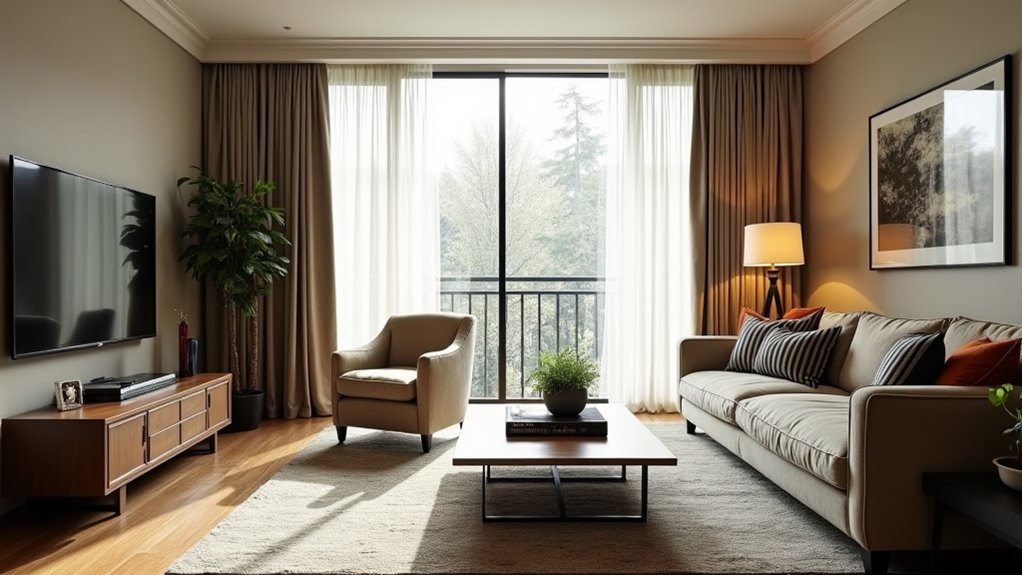

Nearly 7 in 10 rooms look “off” because the rug and curtains are sized wrong. If your rug is too small, it floats and breaks the seating zone; if it’s bunched or curling, it creates visual clutter and trip hazards. When your curtains are too short, too narrow, or hung too low, they shrink the wall and pull the ceiling down. Fixing these basics takes a few measured steps—and one common assumption you’re probably making.
Rug Size Rules (And the Too-Small Mistake)
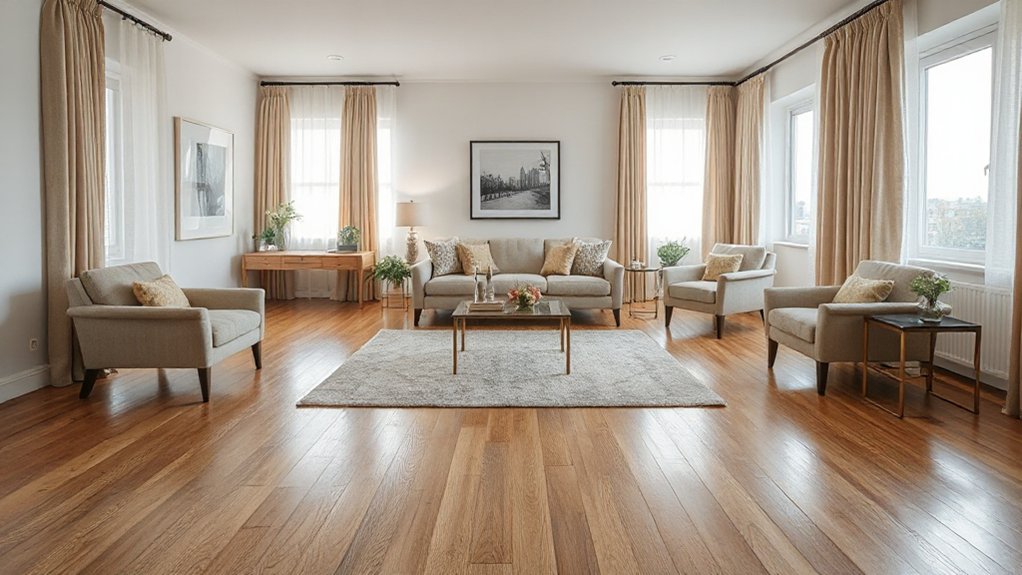
Although you can find endless rug patterns and price points, the size does most of the heavy lifting in how your room feels.
In a living room, choose a rug that lets at least the front legs of every main seating piece sit on it; better yet, fit all legs on for a grounded layout.
In bedrooms, run the rug under the bed and extend it 18–24 inches on the sides and foot so you’re not stepping onto cold flooring.
In dining rooms, size up so chairs stay on the rug when pulled out.
Don’t let Rug fiber distract you from scale.
Also coordinate Curtain hardware height early so panels clear furniture and don’t visually compete with the rug’s footprint.
Rug Placement Mistakes That Make Rooms Feel Smaller
If you place a rug like a floating “island” in the middle of the floor, you’ll shrink the room’s usable footprint and make the layout feel disconnected. Instead, anchor seating by placing at least the front legs of sofas and chairs on the rug, or run the rug fully under a dining table so chairs stay on it when pulled out.
Don’t rotate a rug off-axis to “fit” around door swings; align it with the room’s longest sightline to extend perceived depth.
In narrow spaces, avoid stopping the rug short of key pathways—leave consistent border spacing to keep circulation clear. Keep edges flat; curled corners create visual clutter and complicate rug cleaning.
Finally, coordinate rug placement with curtain hardware locations so furniture doesn’t block drapery movement.
Curtain Length and Width Mistakes (Panel Sizing)
If you choose the wrong curtain panel length, you’ll throw off the room’s proportions—too short looks skimpy, and too long puddles and collects dust.
You also can’t ignore width: panels that don’t provide enough fullness sit flat and make the window look undersized.
Measure from your installed rod height to the finished hem, then size total panel width to at least 2× the window (more for sheers) so you get clean, intentional drape.
Choosing Wrong Panel Length
Why do curtains that looked perfect online end up feeling awkward in your room? You’ve probably chosen the wrong panel length, which throws off curtain proportions and makes ceilings look lower or windows look stunted.
Measure from where you’ll mount the rod (not the top of the window frame) to your intended end point: just brushing the floor, breaking slightly, or stopping at the sill for café-style coverage. Don’t let panels “float” above the floor; even a 1–2 inch gap reads accidental.
If you’re using rings or clips, add their drop to your measurement.
For a clean, tailored look, hang the rod 4–8 inches above the frame and extend it past the casing so panels clear the glass when open.
Incorrect Curtain Fullness
Even when you nail the length, skimpy curtain fullness makes a room look underdressed and can leave the window feeling oddly narrow. You’ll see flat, lifeless pleats and gaps when panels don’t have enough width to stack and overlap.
Aim for 2x to 2.5x fullness: multiply your rod length (excluding finials) by 2 for tailored looks and by 2.5 for softer fabric draping. If you’re using sheer panels, go closer to 2.5x to prevent transparency gaps.
With heavy linen or velvet, 2x usually reads rich without bulk. Check the “finished width” on the label, not the flat, unfolded width. When you open curtains, you should still have visible ripples, not stretched straight lines.
Curtain Height Mistakes That Visually Lower Ceilings
If you hang curtains too low, you shorten the wall and make the ceiling feel closer than it is.
Placing the rod right at the top of the window frame compounds the problem by capping the eye line instead of lifting it.
When you’ve got limited headroom, don’t skip ceiling-mount tracks or rods—they keep panels starting high and preserve vertical scale.
Hanging Curtains Too Low
Although it seems like a small placement choice, hanging curtains too low visually drags the top of the window downward and makes your ceilings feel shorter. You lose vertical lift, especially in rooms with standard-height walls, because the fabric creates a strong horizontal break line.
Correct it by mounting your panels so they begin just below the ceiling line or at the top trim line, then let them fall straight to the floor for a clean column effect. Choose full-length panels, and avoid café or mid-window lengths unless privacy demands it.
When you coordinate Wall mounted accessories—hooks, tiebacks, and holdbacks—keep them aligned to support the taller silhouette. Evaluate Window treatment styles by how they emphasize height, not just pattern or color alone.
Rod Placement Near Window
When you place the curtain rod too close to the window frame, you cap the wall above it and make the ceiling line feel lower than it is. To correct it, mount the rod higher on the wall—typically 4–8 inches above the trim, or halfway to the ceiling in standard rooms.
Extend the rod 6–12 inches beyond each side of the window so panels stack off the glass and the opening looks wider. Match this placement to your window treatment styles: stationary side panels can go higher, while functional drapes need clearance to travel freely.
Use solid rod installation techniques: locate studs or use rated anchors, level the brackets, and choose a rod diameter that won’t bow under fabric weight.
Skipping Ceiling-Mount Options
Even in rooms with decent wall height, skipping a ceiling-mount curtain track can visually chop the wall and make your ceiling feel lower. When you hang drapery from wall mounted fixtures above the window frame, you create a hard horizontal line that stops the eye.
Use Ceiling mount options whenever you can, especially in small rooms, low ceilings, or narrow windows. Mount the track tight to the ceiling or crown, then run panels to just kiss the floor. Keep the stack-back wide so glass stays clear, and choose ripplefold or pinch-pleat headers for a clean vertical drop.
If you must use wall mounted fixtures, place the rod as high as possible and extend it 6–12 inches past the casing on each side.
Rug and Curtain Color Mistakes (Undertones Included)
If you want your room to feel cohesive instead of accidentally “off,” you’ve got to treat rug and curtain color as a matched system, not two separate decisions. First, check each material’s Color undertone in daylight: a “white” curtain can lean blue, cream, or pink, and that shift will fight a rug with the opposite base.
Next, decide whether you want calm continuity or defined contrast, then build contrast harmony on purpose. If your rug is warm (rust, camel, terracotta), pick curtains in warm neutrals (ivory, oatmeal) or a controlled warm accent. If your rug is cool (charcoal, navy, slate), stay cool with crisp white, gray, or icy hues.
Finally, match saturation levels so neither looks faded or loud.
Pattern Mixing: Scale and Spacing Mistakes to Avoid
Because rugs and curtains cover the largest visual real estate in a room, their patterns need a clear hierarchy—otherwise the space reads busy or accidentally mismatched. Start by choosing a “lead” pattern and a “supporting” one.
If your rug has a bold, large motif, keep curtains quieter: solid, subtle stripe, or tiny repeat. If curtains are the statement, ground them with a simpler rug.
Prioritize scale balance by separating repeats: pair large with small, or medium with solid; avoid large-on-large unless one pattern is low-contrast. Watch spacing, too—two tight repeats can vibrate visually.
For Pattern coordination, repeat one color and one line style (curved or geometric) across both textiles, then vary the pattern size.
Rug Materials That Don’t Hold Up to Traffic
Once you’ve balanced rug and curtain patterns, make sure the rug can handle how the room actually gets used—traffic will punish the wrong fiber fast. Avoid viscose, bamboo silk, and other rayon blends in hallways or family rooms; they crush, fuzz, and show water marks.
Loose, high-pile shags and tufted wool also track badly, trapping grit that cuts fibers from the base up. If you need wool, choose tightly woven loop or flatweave, and vacuum frequently.
For busy entries and kitchens, prioritize Outdoor durability with solution-dyed polypropylene or PET; you’ll get better stain resistance and fewer permanent paths. Check the backing, too—cheap latex can crack and ripple under repeated turns and chair legs.
Curtain Fabric Weight: Sheer vs Lined vs Blackout
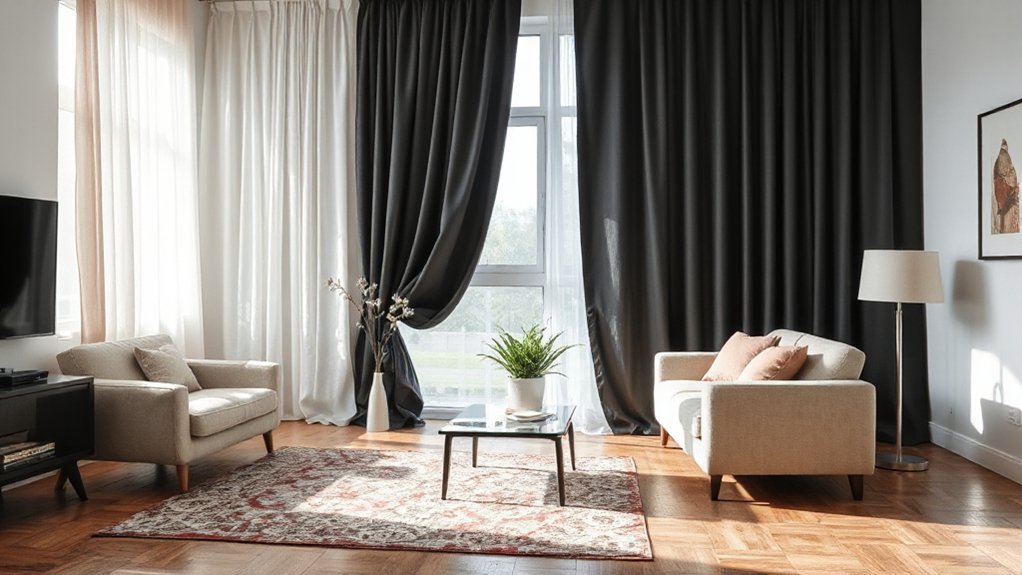
While pattern and color get most of the attention, curtain weight controls how the room actually feels and functions. Choose sheers when you want soft Light filtration, daytime privacy, and a relaxed look, but don’t expect insulation or glare control.
Add a liner when you like the airy face fabric yet need better temperature buffering, improved drape, and more consistent privacy at night; it also boosts Fabric durability by protecting fibers from UV and abrasion at the hem.
Use blackout panels in bedrooms, nurseries, and media rooms to block streetlights and morning sun, but hang them on sturdy hardware and allow extra width so they don’t gap.
If you pick weight that doesn’t match your window’s exposure, you’ll fight fading, drafts, and unwanted light daily.
Rug Pads, Pile, and Texture Mistakes Underfoot
Curtains set the mood at eye level, but rugs handle the daily wear where you walk, drag chairs, and play with pets and kids. Skip the biggest underfoot mistake: buying a rug without Rug padding. Match the pad to the floor—felt for hardwood, rubber for tile, and a combo for high-traffic zones—so the rug won’t creep, curl, or chew up finishes.
Don’t ignore pile texture. A plush, high pile looks cozy but traps grit and snags under dining chairs; choose low pile or flatweave there. In bedrooms, medium pile works if you vacuum weekly. For pets, avoid looped piles that catch claws.
Finally, keep textures consistent across adjacent rugs, or you’ll create awkward height changes and trip points.
Conclusion
Treat your rug and curtains like the room’s foundation and frame: get them wrong, and everything tilts. Choose a rug large enough to anchor furniture, lay it flat with a proper pad, and pick piles and fibers that can take daily footsteps. Hang curtains high, wide, and long enough to kiss the floor, and size panels for true fullness. Match undertones, balance pattern scale, and select fabrics that suit light and traffic.