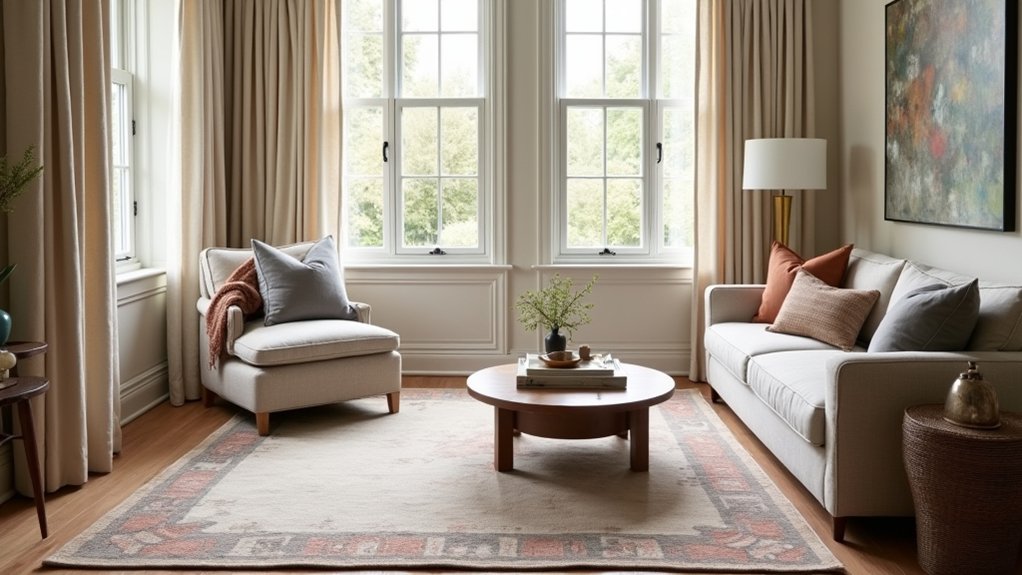

In most room makeovers, the rug and curtains decide the outcome like a lead actor setting the tone. You’ll get a cleaner, more intentional look when you choose one as the anchor and let the other support it. Pull one or two shared hues, then balance scale so patterns don’t compete and solids don’t fall flat. But the real difference shows up when you factor in proportion, texture, and wall color…
Start With One Anchor: Rug or Curtains
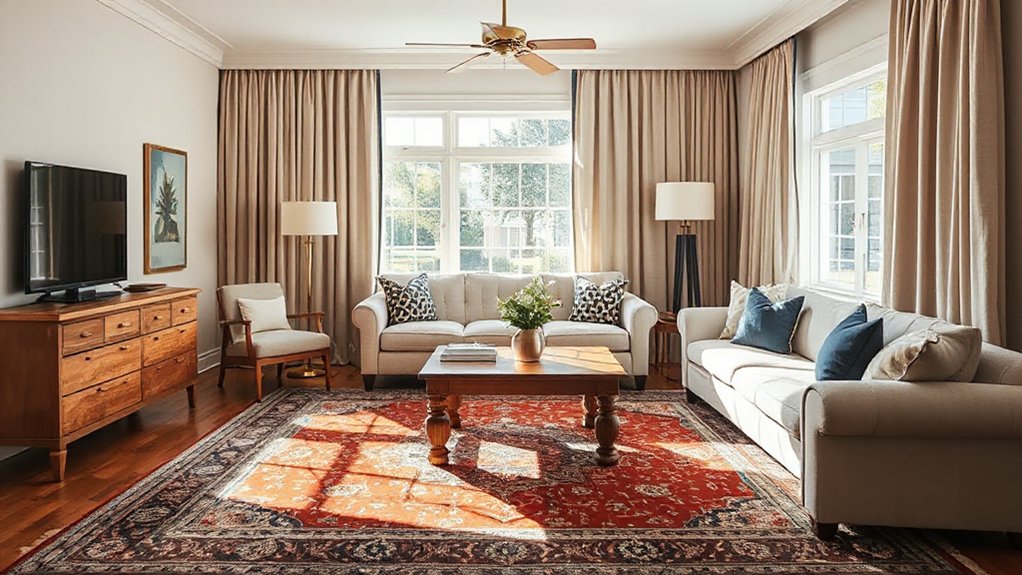
Where should you start when you’re matching rugs and curtains—underfoot or at the window? Choose one anchor so the rest of the room follows a clear hierarchy.
If your rug has a bold pattern, lock it in first and keep curtains quieter in scale and texture.
If your curtains define the room’s height or light control, commit to them first and choose a rug that supports their visual weight.
Use Layering techniques: pair a flatweave with a plush topper, or hang sheers beneath structured panels to control glare and depth.
Plan Seasonal updates by swapping a lightweight rug or linen panels while keeping your anchor constant.
This approach prevents competing focal points and keeps edits intentional.
Pick a Shared Color to Match Rugs and Curtains
Once you’ve chosen your anchor—rug or curtains—pull a single shared color from it to create an intentional link across the room. Treat that hue as your “bridge” and repeat it in the other textile, even if everything else differs.
For Color harmony, decide whether you want a close match or a controlled contrast: match within one to two tonal steps for a calm, tailored feel, or shift lighter/darker for depth. Use shade coordination to account for undertones—warm ivory against warm beige, cool gray against crisp white—so the pairing doesn’t look accidental.
If the anchor color feels too bold, use it as a trim, edging, or subtle weave instead. Aim for consistency under both daylight and evening lamps, too.
Match Rug and Curtain Patterns Without Clashing
To match rug and curtain patterns without clashing, you’ve got to balance scale and motifs—pair a large, bold rug pattern with a tighter, simpler curtain print (or reverse it).
Keep one pattern dominant and let the other support it, so the room reads intentional, not noisy.
Anchor the mix with solid elements—think a solid curtain panel, neutral wall color, or plain upholstery—to give your eye a clean resting point.
Balance Scale And Motifs
Although mixing patterns can elevate a room fast, you’ll only get a polished result when you balance scale and motifs between the rug and curtains. Start by choosing one dominant pattern and one supporting pattern.
If your rug has a large medallion or bold geometrics, pick curtains with a smaller repeat so your eye can rest; if the rug reads as micro-patterned, you can go larger overhead. This scale harmony keeps contrast intentional, not chaotic.
Next, lock in motif coordination: repeat a shape family (stripes with linear geometrics, florals with organic vines) or echo a key detail like a border, trellis, or ikat edge. Keep the palette aligned, then vary density—open lines versus filled-in motifs—to avoid visual noise.
Anchor With Solid Elements
When both your rug and curtains carry pattern, you’ll get a cleaner, more intentional look by anchoring the room with solid elements in between. Start with a quiet sofa or bed covering in a single color pulled from either pattern, then echo it on walls, trim, or a lampshade to create a visual “rest stop.”
Anchor with solid elements like a plain wool throw, a leather ottoman, or a lacquered side table so your eye isn’t forced to read two prints at once. Use contrasting textures to keep solids from feeling flat: nubby linen, smooth velvet, matte ceramics, and woven baskets add depth without adding more pattern.
Finish with one solid border—tape trim, piping, or a bound rug edge—to frame the mix cleanly.
Get Rug Size and Curtain Length Proportions Right
Start by sizing your rug to the room, not the sofa—aim to anchor the main furniture legs so the layout reads intentional, not floating.
Then set your curtain drop to flatter the architecture: hang the rod high and go longer for height, or keep it crisp to the sill when you need a tailored look.
When rug scale and curtain length feel proportional, the whole space looks polished and cohesive.
Balance Rug-To-Room Scale
Because scale sets the tone before color ever does, you’ll want your rug and curtains to “land” in the room at the right proportions.
Start by sizing the rug to the furniture zone: in a living room, aim for front legs on the rug (or all legs, if space allows) so seating feels anchored, not floating.
In bedrooms, let the rug extend beyond the bed’s sides to frame the silhouette and calm the layout.
Then let curtains visually support that footprint: fuller drapery balances a generous rug, while a leaner panel suits tighter square footage.
Use Layered textures to add depth without bulk, and rely on Color coordination to keep large surfaces cohesive rather than visually noisy.
Choose Proper Curtain Drop
Although your rug sets the room’s footprint, the curtain drop controls the vertical read, so you’ll want both proportions to agree.
If you’ve sized a generous rug that anchors key furniture, commit to a longer curtain length to match that intentional scale. Hang rods high—near the ceiling or at least 6–8 inches above the frame—and extend them past the window so panels stack cleanly.
Aim for curtains that kiss the floor for tailored polish, or puddle slightly only in formal rooms; avoid hovering hems that shrink the space.
Calibrate fabric textures too: heavier weaves need cleaner breaks, sheers can float.
Choose curtain hardware that supports the weight and echoes the rug’s visual heft (sleek metal for flatweaves, substantial brackets for plush piles).
Use Texture to Match Rugs and Curtains
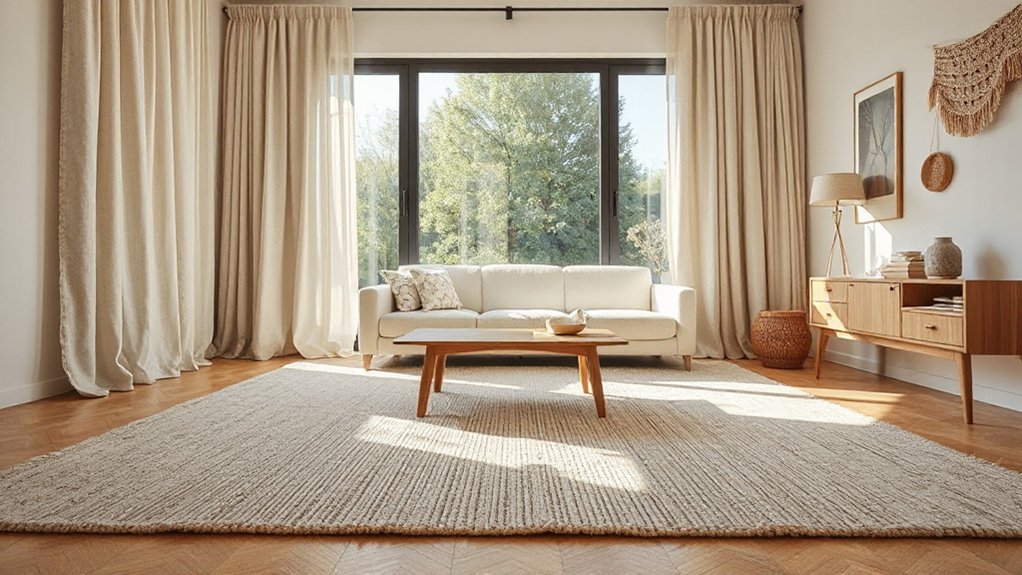
When you match rugs and curtains by texture, you control how the room feels just as much as how it looks. Start by balancing Fabric thickness: pair a chunky wool or high-pile rug with medium-weight drapery to prevent the space from feeling heavy, or offset a flatweave rug with thicker linen to add body.
Track Weave patterns too—bouclé, herringbone, and ribbed weaves read tailored, while shag, loop, and plush textures feel relaxed. Keep one surface visually dominant and let the other support it.
If your rug has pronounced texture, choose curtains with a smoother hand and a crisp hang; if curtains are slubby or nubby, pick a tighter, low-profile rug. This gives cohesion without sameness.
Make Rugs and Curtains Work With Wall Color
Even if your rug and curtains coordinate perfectly with each other, the wall color sets the baseline they’ve to live on. Start by reading your walls as warm, cool, or neutral; that temperature decides whether your textiles look intentional or off. Use color psychology: soft greens and blues calm, warm whites and terracottas energize, charcoal or navy adds depth.
Then control contrast. On light walls, choose a rug with a deeper ground and curtains that echo one rug accent. On dark walls, lift the room with lighter drapery and a rug that includes both wall and curtain tones.
Finally, check material compatibility. Matte paint pairs best with nubby wool, linen, or cotton. Glossy or lacquered walls can handle silkier curtains and tighter-weave rugs without looking flat.
Match Rugs and Curtains to Your Sofa and Pillows
Wall color sets the backdrop, but your sofa and pillows carry the room’s day-to-day palette, so use them to lock your rug and curtains into a clear plan. Start with your sofa as the anchor: pull one dominant tone from it into the rug field, then echo a secondary tone in the curtain fabric for tight Color coordination.
Let your pillows do the accent work—repeat their pattern scale or a trim color in the rug border or curtain edge band. If your sofa is textured (bouclé, leather), choose smoother curtains and a more tactile rug for intentional Material contrast.
With a solid sofa, you can push pattern into either the rug or curtains, not both, and keep pillows as the bridge between them.
Foolproof Rug-and-Curtain Combos: and Mistakes to Avoid
Because rugs and curtains read as one continuous plane from floor to window, you’ll get the most reliable results by pairing them in proven formulas: a grounded neutral rug with tone-on-tone curtains (ivory rug + warm white linen), a patterned rug with solid curtains that pick up one pigment (rust-and-navy rug + navy drapes), or a natural-fiber rug with softly textured panels (jute + oatmeal bouclé).
Lock the look with Layering techniques: add a thin felt pad, then a smaller accent rug only if it echoes the drape’s texture, not its motif.
Keep lighting considerations front and center—north light cools whites, so choose creamier curtains; strong sun fades saturated rugs, so use lined panels.
Avoid equal-match patterns, icy sheers on warm rugs, and curtains that stop above the floor.
Conclusion
When you match rugs and curtains, you’re conducting the room’s orchestra—start with one anchor, then let everything else follow its lead. Pull one shared hue, adjust for lighting, and balance bold patterns with quieter solids so nothing competes. Get proportions right: the rug should ground key furniture, and curtains should kiss the floor. Layer texture for depth, tie into wall color, and echo tones in sofas and pillows. Avoid mismatched scales and jarring contrasts.